QuickBooks TLG Data Recovery: Recover Lost Transactions Safely

Financial data is one of the most valuable assets a business owns.
Every invoice sent to a customer, every vendor payment, every payroll entry, and every bank reconciliation contributes to a complete financial picture. When that information becomes incomplete because recent transactions disappear, businesses often discover how dependent they are on accurate accounting records.
One file that plays an important role in protecting those records is the QuickBooks Transaction Log (TLG) file.
Although many QuickBooks users have seen files with the .TLG extension sitting beside their company file, few understand their purpose until something goes wrong. A damaged QBW company file, an unexpected system shutdown, hardware failure, or backup issue can leave businesses searching for ways to recover recent accounting activity.
This is where QuickBooks TLG Data Recovery becomes important.
Rather than manually recreating days or even weeks of accounting work, a professional recovery process may help restore transactions recorded in the Transaction Log File, reducing the impact of unexpected data loss and helping businesses resume operations more quickly.
What Is a QuickBooks TLG File?
A QuickBooks Transaction Log (TLG) file is created alongside your QuickBooks Desktop Company File (QBW).
Its primary purpose is to record changes made to the company file after a full backup has been created.
Whenever users enter invoices, record payments, update customer balances, create journal entries, or perform other accounting activities, QuickBooks writes information to the transaction log. This helps support certain recovery scenarios and allows QuickBooks to keep track of changes between backups.
Think of the QBW file as the complete accounting database and the TLG file as a running record of recent activity.
If the company file experiences an unexpected problem, the Transaction Log may contain information that assists in recovering transactions that have not yet been included in a backup.
When Does TLG Data Recovery Become Necessary?
Businesses usually don't think about the Transaction Log until they experience data loss.
Some common situations include:
The QuickBooks company file becomes corrupted.
A computer crashes before a scheduled backup.
The latest backup is several days old.
Recent accounting transactions are missing.
The QBW file cannot be opened.
Hardware failure damages accounting files.
Windows unexpectedly shuts down while QuickBooks is running.
In these situations, the Transaction Log may become an important source of recovery information, particularly when businesses need to recover work completed after the most recent backup.
However, every situation is different. The success of recovery depends on factors such as the condition of the QBW file, the availability of the TLG file, and whether the files have been overwritten or damaged.
Why Losing Recent Transactions Can Be More Serious Than Losing the Company File
Most businesses create backups.
The challenge is that backups represent a specific point in time.
Imagine your company performs a backup every Friday evening.
On Thursday afternoon of the following week, the computer's hard drive fails.
The backup still exists.
But nearly six days of accounting work may not.
Those missing records could include:
Customer invoices
Vendor bills
Inventory adjustments
Bank deposits
Payroll transactions
Journal entries
Customer payments
Sales tax records
Recreating this information manually isn't just time-consuming—it also increases the risk of errors.
A successful QuickBooks TLG Data Recovery project focuses on recovering those more recent transactions whenever possible, helping reduce manual data entry and preserving business continuity.
Why QuickBooks TLG Files Become Unusable
Many business owners assume the TLG file stops working only when the QuickBooks company file (QBW) becomes corrupted.
In reality, several situations can affect the Transaction Log File and reduce its usefulness during a recovery attempt.
Understanding these causes helps businesses respond more effectively and avoid making the problem worse.
Some of the most common reasons include:
· Sudden power failures while QuickBooks is open
· Hard drive or SSD failure
· Windows system crashes
· Malware or ransomware attacks
· Accidental deletion of QuickBooks files
· File system corruption
· Interrupted backup processes
· Network interruptions in multi-user environments
· Improper shutdown of the QuickBooks Database Server Manager
· Third-party software interfering with QuickBooks files
Although these situations differ, they all have one thing in common—they can interrupt the relationship between the QBW company file, the TLG file, and the most recent accounting transactions.
What Information Can a TLG Recovery Potentially Restore?
One of the biggest misconceptions about Transaction Log recovery is that it can rebuild every damaged QuickBooks company file.
That's not how the process works.
A TLG recovery is designed to help recover recent accounting activity that may not yet exist in your latest backup.
Depending on the condition of the files, recoverable information may include:
· Customer invoices
· Customer payments
· Vendor bills
· Bill payments
· Bank deposits
· Checks
· Journal entries
· Sales receipts
· Credit memos
· Inventory adjustments
· Purchase Orders
· Sales Orders
· General Ledger activity
· Accounts Receivable updates
· Accounts Payable updates
The actual outcome depends on the health of the QBW, TLG, and available QBB backup.
Because every recovery case is unique, the files should always be evaluated before estimating what can be restored.
What a TLG File Cannot Do
This is where many recovery attempts go wrong.
Some businesses expect the Transaction Log to function as a complete backup.
It doesn't.
A TLG file is not intended to replace a verified QuickBooks Backup (QBB).
If the Transaction Log itself is missing, overwritten, heavily damaged, or no longer synchronized with the company file, recovery options may become limited.
Likewise, if no usable backup exists, the recovery strategy may differ significantly from a standard TLG restoration.
Understanding these limitations helps businesses make informed decisions instead of relying on unrealistic expectations.
Mistakes That Can Reduce Recovery Success
When accounting data appears to be missing, the natural reaction is to start experimenting.
Ironically, this is often what makes recovery more difficult.
Some of the most common mistakes include:
Continuing to Work in the Damaged Company File
Adding new transactions after data loss can overwrite information that may still be recoverable.
Deleting the TLG File
Many users mistakenly believe the .TLG file is unnecessary and remove it while troubleshooting.
In some recovery situations, that file contains valuable information.
Rebuilding the Company File Without Understanding the Problem
Running repair utilities without first identifying the underlying issue may complicate the recovery process.
Restoring an Old Backup Without Preserving Current Files
Businesses sometimes overwrite the existing company file before creating a copy.
If additional recovery becomes necessary later, important evidence may already be gone.
Delaying Recovery
The longer damaged files remain in use, the greater the possibility that recoverable information will be overwritten.
When accounting data is important, acting early usually provides more recovery options.
How a Professional QuickBooks TLG Data Recovery Process Works
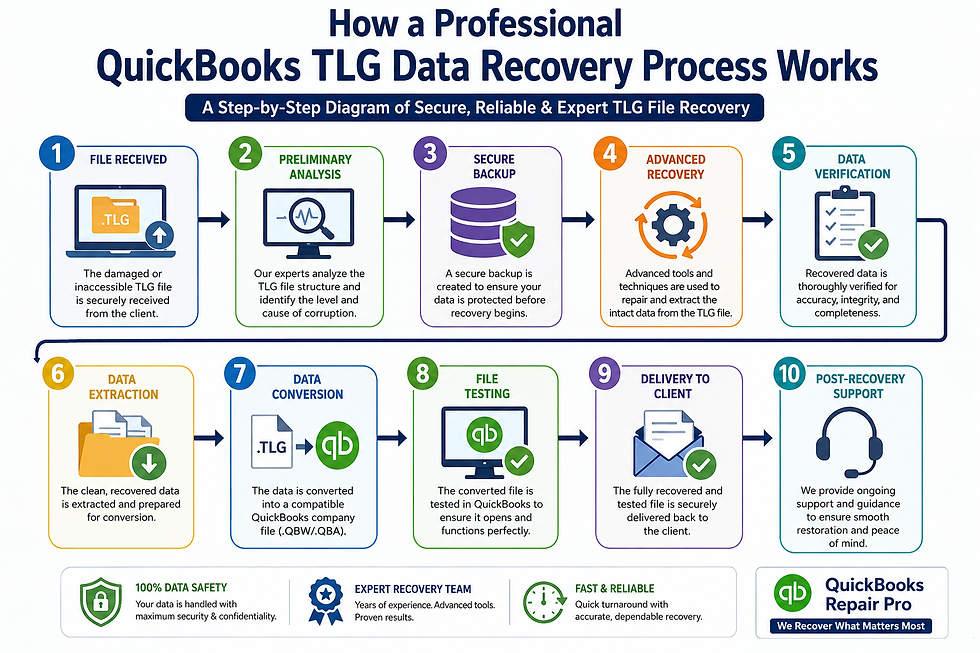
Although every recovery project is different, experienced specialists generally follow a structured workflow rather than immediately attempting repairs.
A typical process includes:
Step 1 — Evaluate the Available Files
The QBW company file, TLG file, and any available QBB backup are reviewed to understand the extent of the problem.
Step 2 — Protect the Original Data
Before any recovery work begins, copies of the available files are created.
This helps preserve the original evidence and reduces the risk of accidental data loss during recovery.
Step 3 — Analyze Data Integrity
The relationship between the company file and Transaction Log is examined to determine whether recent accounting activity can be reconstructed.
Step 4 — Recover Available Transactions
Where possible, recent accounting activity is recovered and integrated into a usable QuickBooks company file.
Step 5 — Validate Financial Reports
Recovery isn't complete simply because the file opens.
Important reports such as the Balance Sheet, Profit and Loss Report, General Ledger, Accounts Receivable, and Accounts Payable should be reviewed to confirm the recovered data is consistent and reliable.
A Business Continuity Issue—Not Just a Technical One
When recent accounting transactions disappear, the impact extends beyond bookkeeping.
Customer invoices may not be collected.
Vendor balances may become inaccurate.
Payroll records may be incomplete.
Tax reporting can become more difficult.
Management decisions may be based on outdated financial information.
For that reason, QuickBooks TLG Data Recovery isn't simply about recovering files.
It's about helping businesses restore confidence in their financial records and minimizing disruption to daily operations.
When Should You Consider Professional QuickBooks TLG Data Recovery?
Not every QuickBooks issue requires Transaction Log recovery.
If your latest backup contains all recent transactions and your company file is healthy, restoring that backup may be the simplest solution.
However, professional QuickBooks TLG Data Recovery becomes worth considering when:
· Your most recent QBB backup is outdated.
· Recent accounting transactions are missing.
· The QBW company file has become damaged or inaccessible.
· The TLG file is still available alongside the company file.
· Re-entering days or weeks of accounting work would consume significant time.
· Your business depends on complete financial records for payroll, tax reporting, or customer billing.
The earlier the files are evaluated, the greater the opportunity to determine which recovery options remain available.
Why Businesses Choose QuickBooks Repair Pro
Recovering QuickBooks data is rarely about opening a damaged file.
It's about understanding how QuickBooks stores accounting information and identifying the safest way to recover it without creating additional problems.
At QuickBooks Repair Pro, every recovery project begins with analysis rather than assumptions.
Instead of immediately attempting repairs, the available QBW company file, TLG file, and QBB backup are carefully reviewed to understand the condition of the accounting database and identify the most appropriate recovery approach.
Our objective is simple:
· Recover available accounting data whenever possible.
· Preserve the integrity of the original files.
· Reduce unnecessary manual data entry.
· Help businesses return to normal operations with reliable financial records.
Whether the issue involves recent transaction loss, file corruption, or an incomplete backup, each recovery project is approached with the goal of protecting the information your business depends on every day.
Best Practices to Reduce Future Data Loss
While no recovery method can eliminate every risk, good data management significantly improves your ability to recover from unexpected problems.
Businesses using QuickBooks Desktop should consider the following practices:
· Create verified QBB backups on a regular schedule.
· Store backup files in a separate physical location or secure cloud storage.
· Avoid deleting TLG or ND files unless specifically instructed during troubleshooting.
· Use a reliable UPS (Uninterruptible Power Supply) to reduce the impact of sudden power failures.
· Keep Windows and QuickBooks updated with supported releases.
· Regularly review the health of the company file using appropriate maintenance procedures.
· Test backup files periodically to ensure they can be restored when needed.
Preparation before a problem occurs is often more valuable than recovery after the fact.
Frequently Asked Questions
Can a TLG file recover every missing transaction?
Not necessarily.
The amount of recoverable data depends on the condition of the QBW company file, the TLG file, the latest QBB backup, and whether the required information still exists within those files.
Is the TLG file the same as a QuickBooks backup?
No.
A TLG file records changes made after a backup, while a QBB file is a complete backup of the QuickBooks company file. They serve different purposes and often work together during certain recovery scenarios.
Can I delete the TLG file to save disk space?
It is generally not recommended unless you fully understand its purpose and have a verified backup strategy. Removing supporting QuickBooks files without proper planning may reduce recovery options if data loss occurs later.
Will my original company file be modified during recovery?
A professional recovery process should always preserve the original files by working on copies whenever possible. This reduces the risk of accidental changes to the source data.
How long does QuickBooks TLG Data Recovery take?
The timeline depends on several factors, including:
· Company file size
· Severity of corruption
· Availability of the TLG file
· Condition of the backup
· Number of recoverable transactions
Each recovery project should be evaluated individually before estimating completion time.
Final Thoughts
The QuickBooks Transaction Log (TLG) file is one of the least understood components of a QuickBooks Desktop company file, yet it can become extremely valuable when recent accounting activity is missing.
When businesses experience file corruption, hardware failure, or discover that their latest backup is missing important transactions, the Transaction Log may provide an opportunity to recover work that would otherwise need to be recreated manually.
At the same time, it's important to recognize that TLG recovery is not a substitute for a proper backup strategy. The best results come from combining regular QBB backups, healthy QBW company files, and prompt action when problems occur.
If your business has experienced recent data loss, avoid making unnecessary changes to the affected files. A careful evaluation of the available QuickBooks data is often the best first step toward determining the most appropriate recovery approach.


Comments